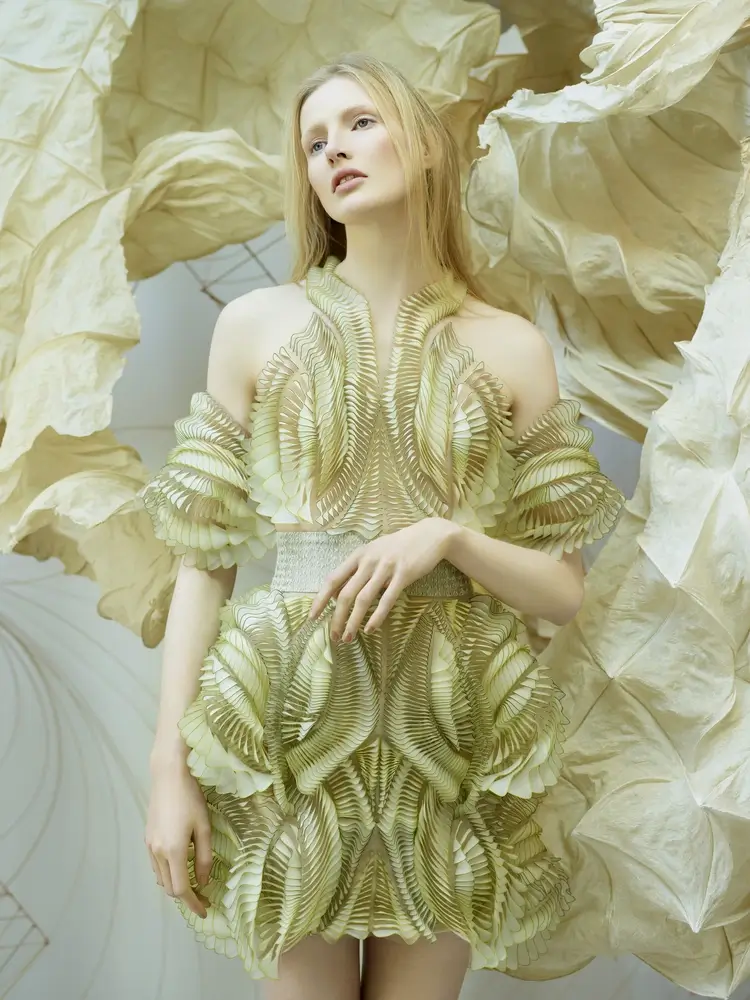

There’s a felt beauty that resonates from a fashion designer who knows herself. Able to explain the subtlety of movement to show a truer depiction of her craft, she sees fluidity in everything. She feels life in everything. She carries less of a desire to boast about the physical quality of her work and more of a need to speak of the unseen realms between it. This is the soft, magnetizing energy of Iris Van Herpen.
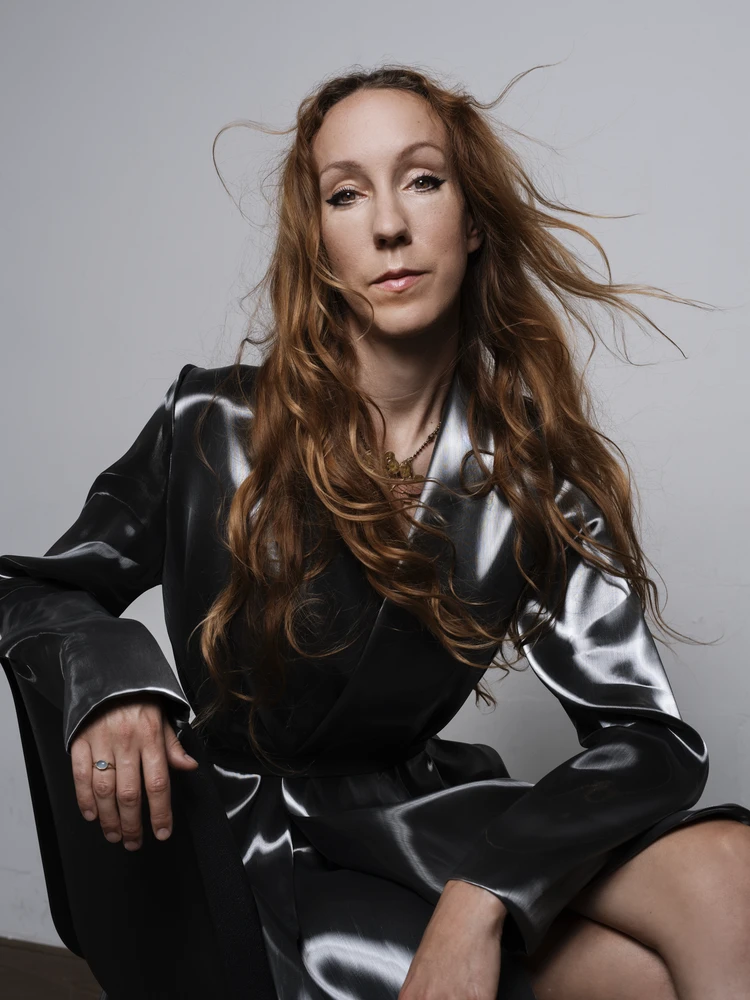
Van Herpen’s ability to alchemize the ethereal is perhaps most evident in her love for fine art and classical ballet. The Dutch fashion designer dipped her toe into the world of art and movement at an early age, garnering a deep understanding of energetic principles and fine-tuning an immense curiosity with herself and those around her. This transformative era in her life could be interpreted as Van Herpen’s catalyst, where she began to quietly finesse her creative eye and see the world with more presence, potency, and poise.
The now 41-year-old designer has spent 18 years perfecting Iris Van Herpen—as a brand, as an individual—and the result is palpable. The feeling she creates is evident in the peculiarity of her work, like her latest innovation that graced the runway at Paris Haute Couture Week–a haunting dress made from 125 million bioluminescent algae. Van Herpen artfully fuses fashion, philosophy, and science in a way that could conjure a fair share of skeptics, yet she has managed to effortlessly draw in a dedicated fanbase who understand her. After experiencing her presence, I was convinced. How could one not be allured by the delicate and daring nature of it all?
Although she values illusionary concepts, Van Herpen’s heart holds a deep connection to the physical world. As technology evolves, the designer fears losing touch with the tangible quality of what makes her designs so impactful, an ideal she may have inherited from her grandmother, who had a secret collection of costumes and relics tucked away in her attic. In light of this, Van Herpen’s focus remains on innovations with real garments as opposed to digital wardrobes or consultations that aren’t face-to-face. She values technological advancements, too. Her exceptional use of 3D printing and laser cutting is a prime part of her creative process that has driven her business to succeed, but human connection is—and always will be—her main draw.
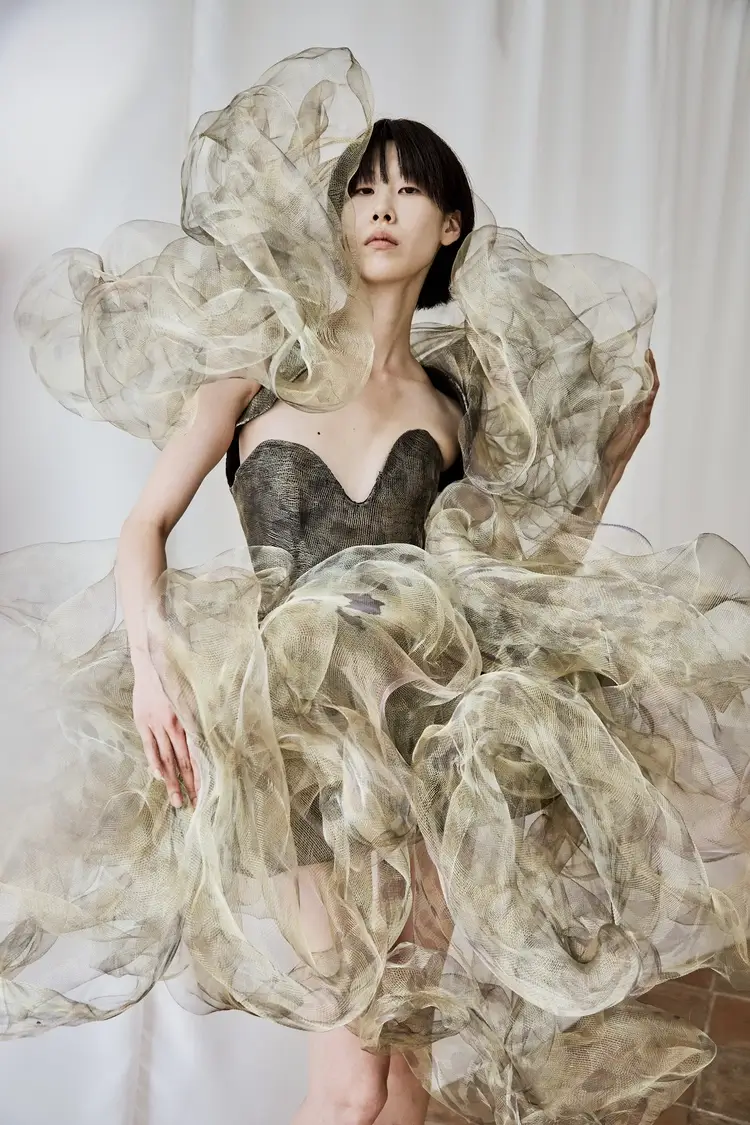
The designer claims to have no singular muse, yet the cycles of nature and undone beauty of the earth are prime sources of inspiration for her. She’s a proponent of being outside, sitting in public parks, and absorbing the local landscape. She finds solace in the garden at her home in Het Twiske, a wetlands nature reserve about a half-hour’s drive north of her studio in Amsterdam, where this hidden refuge allows the designer to sit and ponder life, ground her feet into the earth, and gather ideas. “I see little transformations that are happening every day that are already such a force of life,” Van Herpen said, “and it gives me new energy.”
She sees nature as an evolution. In her eyes, our natural dwelling manages to signify the past, present, and future of how everything came to be in one sitting. “I just feel that I’m in connection with something much bigger than the here and now,” Van Herpen said. “It’s like looking at the stars. It can have that same overwhelming feeling of what we are. I think it’s like putting ourselves into a different perspective, and I think that is always very helpful for finding new creativity,” Van Herpen said.
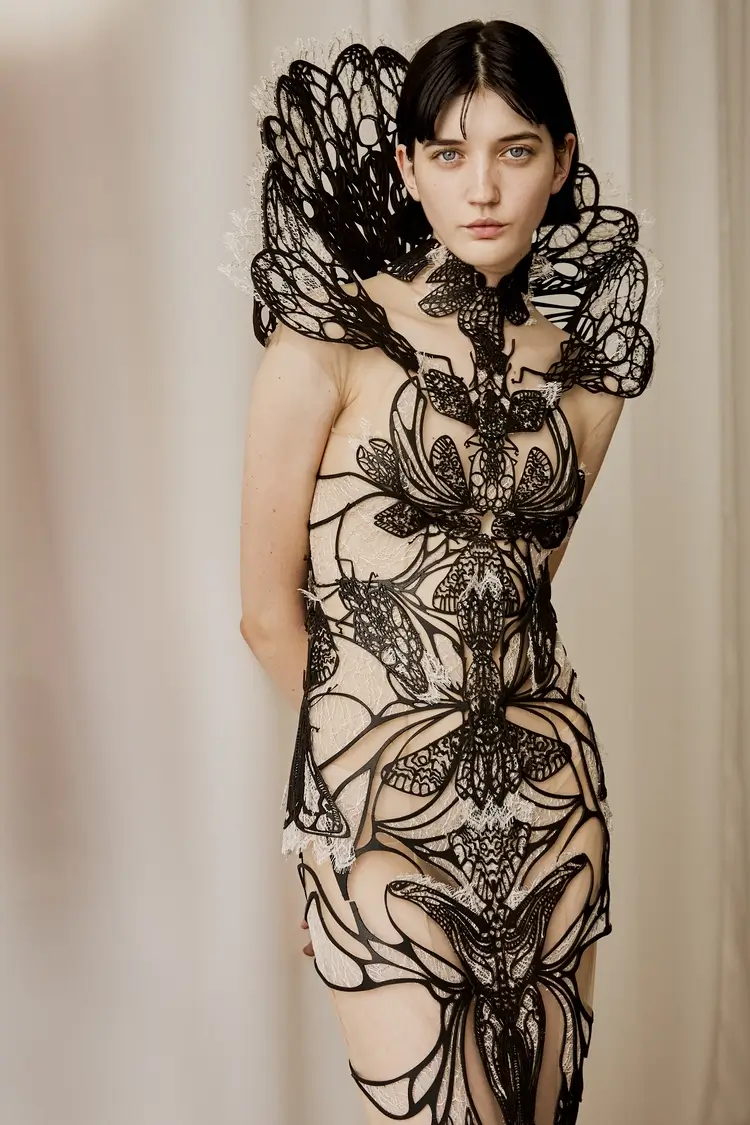
In a beautifully soft way, Van Herpen’s designs suggest an almost otherworldly nature. Her pieces, displayed in art museums and worn by the likes of Lady Gaga, Beyoncé, and Cate Blanchett, are incredibly delicate yet mesmerizingly intricate. Her silent silhouettes and subtle textures aren’t devoid of warmth, they are woven with wonder. One could say her dresses are the embodiment of life: natural, obscure, and ever-evolving. It’s this unspoken element that maintains intrigue and appeal, and it involves reading between the lines–a process that Van Herpen encourages when it comes to sharing interpretations of her breathtaking works of art.
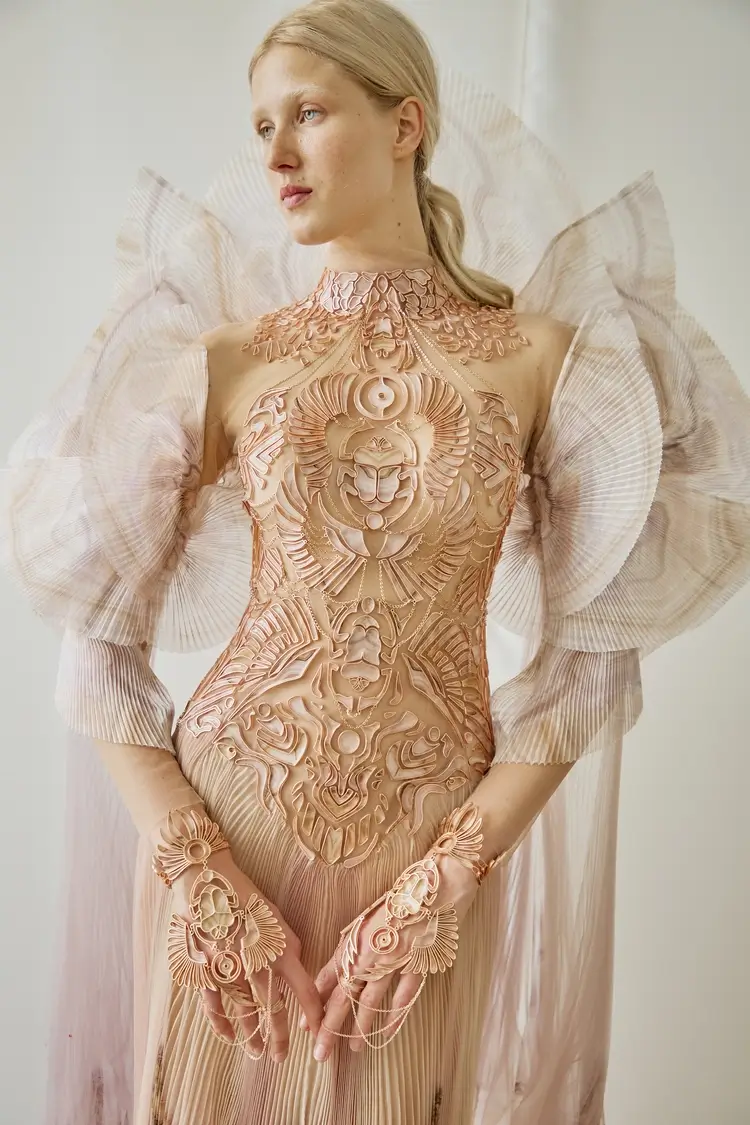
Her designs sharpen curiosity for many reasons. The designer takes a different approach than the average fashion label when she opts for less-obvious relevance to popular culture by paying little attention to trends. In a way, it is her attempt to block out parts of the world that don’t resonate with her cause. Perhaps in an effort to become true to herself and step away from normalcy, she was able to find her niche with a strong sense of humility.
Despite the temptation to evolve into ready-to-wear, the designer intuitively chose to remain in haute couture, and she’s glad that she did. This subtle nuance in approach is what made her so widely successful. “I think in everything that I do, I have to find a balance between taking good advice and really following my intuition,” Van Herpen said. “The fashion industry over the last 40 years has become very easy to get lost in, so I think it’s really about being creative and innovative at the same time.”
Van Herpen released a book, Sculpting the Senses, as an extension of her exhibition catalog and global travel retrospective, which had its debut in the Musée des Arts Décoratifs in Paris, France. It shows in great detail the designer’s creative process using original illustrations to accompany the text and explores Van Herpen’s unique approach to the materiality of fashion from a philosophical perspective. Not only is it a practical rendition for aspiring fashion designers, it’s a beautiful coffee table piece for those who love her, and it can nestle in the nooks of any home. The Limited Artist’s Edition includes a sketch, pattern drawing, and fabric swatch from her own personal atelier. While the original catalog version can be purchased at any one of her museum exhibitions, the Limited Artist’s Edition is only available to buy on her website at irisvanherpen.com.
Coming full circle from the interests of her youth, Van Herpen has designed the costumes for the NYC Ballet Fall Fashion Gala and is in collaboration with choreographers and dancers to saturate her runway shows with an element of the unexpected. This was especially true in her latest show in Paris, called Sympoiesis—a spellbinding laser light reenactment by laser artist Nick Verstand and dancer Madoka Kariya whose body spoke a soft language of the seas. Additionally, her work will be shown in the Brooklyn Museum in 2026. Van Herpen plans to continue her use of intertwining fluidity and fashion in a way that further brings the art of movement to mainstream moments like this one.
“Dance is such a pure form of art, and that really inspires me,” Van Herpen remarked. “I’m trying to show a vision where the expression of our embodiment goes way beyond fashion,” she said as she looked off fondly into the distance. In that moment, it felt as if I was willfully sorting through the folds of her mind, and it was as beautiful as it was enigmatic. Iris Van Herpen, in all her delicate glory, is a force of mystery and grace.